Congrats Sir

Congrats Sir

Thursday, 24 January 2013

STLD I MID IMPORTANT QUESTIONS


STLD  I MID IMPORTANT QUESTIONS
II ECE-A

1. a) Represent the decimal number 7258 in
            i) BCD code    ii) excess-3 code        iii)2421 code    iv) 6311 code
    b) What is a self complementary code? Explain with two examples.

2. a) Perform the following operations using 2’s complement arithmetic:
            i) (+43)10 − (−53)10.              ii) (3E91)16 − (1F93)16
    b) Represent the unsigned decimal numbers 351 and 986 in BCD, and then show the 
         steps necessary to form their sum.

3. a) Explain different methods used to represent negative numbers in binary system.
    b) In a new number system X and Y are successive digits such that (XY)r = (25)10 and
         (YX)r = (31)10 . Find X,Y,r

4. a) What do you understand by canonical and expanded forms of Boolean expressions?
        Illustrate with examples.
    b) Design a logic circuit having three inputs A, B, C such that output is 1 when A = 0 or
        whenever B = C = 1. Also obtain logic circuit using NAND gates.

5. a) It is proposed to construct an eight-input NAND gate using only two-input AND gates
        and two-input NAND gates. Draw the logic arrangement that uses the minimum   
        number of logic gates.
    b) What is a parity bit? Define even and odd parity. What is the limitation of the parity  
         code when it comes to detection and correction of bit errors?

6. a) Explain error correction and error detection codes with examples.
    b) Implement the following Boolean function F using the two-level form
         i) NAND-AND ii) AND-NOR where F (A,B,C,D) =(0,1,2,3,4,8,9,12)

7. a) Explain the fundamental postulates of Boolean algebra
    b) Obtain the compliment and dual for the following expressions
        i) AB + BC + AC  ii) A+B’C(A+B+C’)                  iii) AB+(AC)’+(AB+C)

8. Minimize the following function using tabular minimization and verify the same with
     K-map minimization F=Ï€(0,2,4,5,6,7,8,10,14,17,18,21,29,31) . Ï€d(11,20,22)

9. a) Write a simplified max-term Boolean expression for  Ï€ (0, 4, 5, 6, 7, 10, 14) using the
        Karnaugh mapping method.
    b) Minimizing a given Boolean expression using the Quine–McCluskey tabular method  
        yields the following prime implicants: −0−0, −1−1, 1−10 and 0−00. Draw the  
        corresponding Karnaugh map.

10.a) Write both sum-of-products and product-of-sums Boolean expressions for
        i) a two-input AND gate,    ii) a two-input NAND-gate,    iii) a two-input EX-OR gate and
        iv) a two-input NOR gate from their respective truth tables.
     b) Write the procedure of design of Combinational Circuits.
  

Wednesday, 12 December 2012

Character traits for good leadership

            Character traits for good leadership

Good character makes a good leader. But, delving into character traits for good leadership throws up diverse features like positive attitude, determination, discipline, honesty, integrity, trustworthiness, fairness, humility, courage, creativity, vision, conviction, future-mindedness, emotional intelligence and so on. All of them are important depending on the situation and circumstances.

Let us take a look at some of the crucial character attributes, beginning with vision. Leaders should have a compelling and realistic vision that they stay invested in. This will enable them to set goals, establish a sense of direction, and create a roadmap for the future in a way that inspires employees to go after it. Mr. Rakesh Singh, VP and GM of Citrix India elaborates, “Vision is absolutely crucial because it sets the bar for what the organisation must strive to achieve. Objectives may keep changing along the way, but if you don’t have that big dream, then you don’t know which direction you need to take.”

A forward-looking and future-minded approach is what helps leaders perceive how their actions will affect the future and filter decisions accordingly.

They can envision what will happen, connect it to employees’ hopes and aspirations and communicate the possibilities in the most stimulating manner.

Honesty, integrity, fairness and humility go hand in hand. Abiding to a set of ethics and principles while being honest, transparent, fair and empathetic inspires trust and respect in the workforce. As ApnaCircle.com, Founder and CEO, Mr. Yogesh Bansal points out, “With power comes responsibility and one has to be ethical to be entrusted with that responsibility, so having good work ethics is important. An ethical individual not only builds reliability but also encourages others to work principally.”

A meta-analysis study by Kurt Dirks and Donald Ferrin focuses on the role of trust in leadership. According to their study, trust in leadership is positively correlated with job satisfaction, commitment to the organisation, and negatively related with employees’ intent to quit the organisation.

Mr. Amit Nandkeolyar, Assistant Professor, Organisational Behaviour at Indian School of Business (ISB) adds, “Unless subordinates have trust in the leadership, it is impossible for a leader to be effective. He cannot get anything done by his followers if he does not command trust or is not seen as trustworthy.” A recent survey by Korn-Ferry International, Asia’s leading talent management and leadership development company, on what organisations want from their leaders further reveals that the emphasis is on those who are both ethical and can convey a strong vision of the future.

Humility empowers leaders to admit mistakes, accept dissent and concede to a better viewpoint. This in turn promotes the open-mindedness to learn new things as well. As Mr. Singh adds, “Honesty builds trust and promotes an apolitical environment, both of which are essential for the smooth running of an organisation. Humility helps you stay on a learning curve forever. It also allows a leader to have an open-mind, which is essential to study the competitive environment more objectively.

Also, since the leader often sets the tone of the organisation, humility will have a trickle down effect, which is always good for the organisation.” Mr. Debasis Chatterji, CEO, Netxcell Limited further adds, “Honesty, integrity and humility are the fulcrum of a leadership podium. If a leader does not have these three attributes, it very difficult to perform as expected and he/she will falter under difficult circumstances. The person will then most likely resort to adjustments and compromise and the organisation will suffer.” He further surmises that these three attributes are the building blocks for all other attributes!

Ms. Juhi Mishra, Vice President Human Resources, InterGlobe Technology Quotient too opines on the same note, “A leader is someone who, with his integrity, empowers and motivates his team members to work towards a common objective – growth and stability. An honest and trustworthy leader is likely to have a team that rely on him and stand by him in a crisis situation.”

Emotional intelligence is especially crucial for leaders to be able to make rational, mature and informed decisions without rushing or reacting emotionally. It brings the ability to understand and manage one’s own emotions as well as those of others. Emotionally intelligent leaders can exercise self-discipline on their thoughts and actions and express their emotions in constructive ways. Mr. Bansal also suggests, “Emotional intelligence is required when dealing with a team of individuals. An emotionally intelligent leader would not only be able to deal with his emotional swings but also empathise with and control the team’s emotions and motivate them towards a positive goal.”

Finally, Mr. Nandkeolyar sums up the rising importance of good character in leadership, “A great leader develops shared vision, creates an enabling climate in his team/company, and provides appreciation for the employees.

This is especially important during uncertain times when employees are looking for someone to provide a direction. During such times, leaders serve as beacon for their followers!”

To sum up, what a leader is makes a huge difference in his leadership performance. It makes him capable, dynamic and places him at the forefront for building excellence in the organisation. Not only will he set a good example but also attract followers who will want to emulate him. Therefore, character does count!

Payal Chanania

Thursday, 25 October 2012

II-I 2nd MID DLD& EDC Important Questions


II-I CSE-A II MID DLD IMP Questions

1.  a) Implement the following Boolean function using 4× 1 multiplexer.
          F(A,B,C,D) = ∑m(2,5,8,9,10,14,15)
     b) Construct 4 to 16 line decoder with five 2-to-4 line decoders with enable
         input. Draw and explain the relevant logic diagram.                                         

2.      a) Using PLA logic, implement a BCD to excess-3 code converter. Draw and 
    explain its truth table and logic diagram.
     b) Construct 128×8 ROM using 32×8 ROM chips. Draw and explain the relevant 
         logic diagram.                                                                                                     

3.  a) Realize D-FF and T-FF using JK-FF. Draw the logic diagrams with their truth tables.
     b) Deduce the design procedure for sequential logic circuits
                       
4.  a) Design, draw and explain the 4-bit universal shift register.
     b) Design, draw and explain a 4-bit ring counter using D- flip flops with
          relevant timing diagrams.                                                

5.  a) Implement the following Boolean function using8× 1 multiplexer.
          F(A,B,C,D) = _m(2,5,8,9,10,14,15)
     b) Construct 4 to 16 line decoder with five 2-to-4 line decoders with enable
          input. Draw and explain the relevant logic diagram.

6.  a) A ROM chip of 4,096 × 8 bits has two chip select inputs and operates from a
         5-volt power supply. How many pins are needed for the integrated circuit  
         package? Draw and explain the block diagram of this ROM.
     b) For 3-input, 4-output truth table of a combination logic circuit, derive the PAL 
         programming table and draw the relevant logic diagram.
           XYZ
ABCD
000
001
010
011
100
101
110
111
0100
1111
1011
0101
1010
0001
1110
0111

7. A sequential circuit with two D flip flops A and B, two inputs x and y and one 
    output z is specified by the following next state and output equations.
    i) A(t+1)= x’y xA       ii) B(t+1)= x’B xA        iii) Z=B
    a) Draw the logic diagram. b) List the state table for the sequential circuit.
    c) Draw the state diagram.

8.  a) Design, draw and explain a modulo -12 up synchronous counter using T- 
         flip flops.
     b) Draw and explain the logic diagram for a 4-bit binary ripple down counter
         using positive edge triggered flip-flops.

Saturday, 20 October 2012

Engineers Day Celebrations


Monday, 1 October 2012

Mahatma Gandhi

 Mohandas Karamchand Gandhi was born in the town of Porbander in the state of what is now Gujarat on 2 October 1869. He had his schooling in nearby Rajkot, where his father served as the adviser or prime minister to the local ruler. Though India was then under British rule, over 500 kingdoms, principalities, and states were allowed autonomy in domestic and internal affairs: these were the so-called 'native states'. Rajkot was one such state.

Gandhi later recorded the early years of his life in his extraordinary autobiography, The Story of My Experimentswith Truth. His father died before Gandhi could finish his schooling, and at thirteen he was married to Kasturba [or Kasturbai], who was of the same age as Mohandas himself . In 1888 Gandhi set sail for England, where he had decided to pursue a degree in law. Though his elders objected, Gandhi could not be prevented from leaving; and it is said that his mother, a devout woman, made him promise that he would keep away from wine, women, and meat during his stay abroad. Gandhi left behind his son Harilal, then a few months old.

In London, Gandhi encountered theosophists, vegetarians, and others who were disenchanted not only with industrialism, but with the legacy of Enlightenment thought. They themselves represented the fringe elements of English society. Gandhi was powerfully attracted to them, as he was to the texts of the major religious traditions; and ironically it is in London that he was introduced to the Bhagavad Gita. Here, too, Gandhi showed determination and single-minded pursuit of his purpose, and accomplished his objective of finishing his degree from the Inner Temple. He was called to the bar in 1891, and even enrolled in the High Court of London; but later that year he left for India.
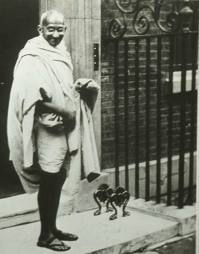
After one year of a none too successful law practice, Gandhi decided to accept an offer from an Indian businessman in South Africa, Dada Abdulla, to join him as a legal adviser. Unbeknown to him, this was to become an exceedingly lengthy stay, and altogether Gandhi was to stay in South Africa for over twenty years. The Indians who had been living in South Africa were without political rights, and were generally known by the derogatory name of 'coolies'. Gandhi himself came to an awareness of the frightening force and fury of European racism, and how far Indians were from being considered full human beings, when he when thrown out of a first-class railway compartment car, though he held a first-class ticket, at Pietermaritzburg. From this political awakening Gandhi was to emerge as the leader of the Indian community, and it is in South Africa that he first coined the term satyagraha to signify his theory and practice of non-violent resistance. Gandhi was to describe himself preeminently as a votary or seeker of satya (truth), which could not be attained other than through ahimsa (non-violence, love) and brahmacharya (celibacy, striving towards God). Gandhi conceived of his own life as a series of experiments to forge the use of satyagraha in such a manner as to make the oppressor and the oppressed alike recognize their common bonding and humanity: as he recognized, freedom is only freedom when it is indivisible. In his book Satyagraha in South Africa he was to detail the struggles of the Indians to claim their rights, and their resistance to oppressive legislation and executive measures, such as the imposition of a poll tax on them, or the declaration by the government that all non-Christian marriages were to be construed as invalid. In 1909, on a trip back to India, Gandhi authored a short treatise entitled Hind Swaraj or Indian Home Rule, where he all but initiated the critique, not only of industrial civilization, but of modernity in all its aspects.

Gandhi returned to India in early 1915, and was never to leave the country again except for a short trip that took him to Europe in 1931. Though he was not completely unknown in India, Gandhi followed the advice of his political mentor, Gokhale, and took it upon himself to acquire a familiarity with Indian conditions. He traveled widely for one year. Over the next few years, he was to become involved in numerous local struggles, such as at Champaran in Bihar, where workers on indigo plantations complained of oppressive working conditions, and at Ahmedabad, where a dispute had broken out between management and workers at textile mills. His interventions earned Gandhi a considerable reputation, and his rapid ascendancy to the helm of nationalist politics is signified by his leadership of the opposition to repressive legislation (known as the "Rowlatt Acts") in 1919. His saintliness was not uncommon, except in someone like him who immersed himself in politics, and by this time he had earned from no less a person than Rabindranath Tagore, India's most well-known writer, the title of Mahatma, or 'Great Soul'. When 'disturbances' broke out in the Punjab, leading to the massacre of a large crowd of unarmed Indians at the Jallianwala Bagh in Amritsar and other atrocities, Gandhi wrote the report of the Punjab Congress Inquiry Committee. Over the next two years, Gandhi initiated the non-cooperation movement, which called upon Indians to withdraw from British institutions, to return honors conferred by the British, and to learn the art of self-reliance; though the British administration was at places paralyzed, the movement was suspended in February 1922 when a score of Indian policemen were brutally killed by a large crowd at Chauri Chaura, a small market town in the United Provinces. Gandhi himself was arrested shortly thereafter, tried on charges of sedition, and sentenced to imprisonment for six years. At The Great Trial, as it is known to his biographers, Gandhi delivered a masterful indictment of British rule.


Owing to his poor health, Gandhi was released from prison in 1925. Over the following years, he worked hard to preserve Hindu-Muslim relations, and in 1924 he observed, from his prison cell, a 21-day fast when Hindu-Muslim riots broke out at Kohat, a military barracks on the Northwest Frontier. This was to be of his many major public fasts, and in 1932 he was to commence the so-called Epic Fast unto death, since he thought of "separate electorates" for the oppressed class of what were then called untouchables (or Harijans in Gandhi's vocabulary, and dalits in today's language) as a retrograde measure meant to produce permanent divisions within Hindu society. Gandhi earned the hostility of Ambedkar, the leader of the untouchables, but few doubted that Gandhi was genuinely interested in removing the serious disabilities from which they suffered, just as no one doubt that Gandhi never accepted the argument that Hindus and Muslims constituted two separate elements in Indian society. These were some of the concerns most prominent in Gandhi's mind, but he was also to initiate a constructive programme for social reform. Gandhi had ideas -- mostly sound -- on every subject, from hygiene and nutrition to education and labor, and he relentlessly pursued his ideas in one of the many newspapers which he founded. Indeed, were Gandhi known for nothing else in India, he would still be remembered as one of the principal figures in the history of Indian journalism.

In early 1930, as the nationalist movement was revived, the Indian National Congress, the preeminent body of nationalist opinion, declared that it would now be satisfied with nothing short of complete independence (purna swaraj). Once the clarion call had been issued, it was perforce necessary to launch a movement of resistance against British rule. On March 2, Gandhi addressed a letter to the Viceroy, Lord Irwin, informing him that unless Indian demands were met, he would be compelled to break the "salt laws". Predictably, his letter was received with bewildered amusement, and accordingly Gandhi set off, on the early morning of March 12, with a small group of followers towards Dandi on the sea. They arrived there on April 5th: Gandhi picked up a small lump of natural salt, and so gave the signal to hundreds of thousands of people to similarly defy the law, since the British exercised a monopoly on the production and sale of salt. This was the beginning of the civil disobedience movement: Gandhi himself was arrested, and thousands of others were also hauled into jail. It is to break this deadlock that Irwin agreed to hold talks with Gandhi, and subsequently the British agreed to hold a Round Table Conference in London to negotiate the possible terms of Indian independence. Gandhi went to London in 1931 and met some of his admirers in Europe, but the negotiations proved inconclusive. On his return to India, he was once again arrested.

For the next few years, Gandhi would be engaged mainly in the constructive reform of Indian society. He had vowed upon undertaking the salt march that he would not return to Sabarmati Ashram in Ahmedabad, where he had made his home, if India did not attain its independence, and in the mid-1930s he established himself in a remote village, in the dead center of India, by the name of Segaon [known as Sevagram]. It is to this obscure village, which was without electricity or running water, that India's political leaders made their way to engage in discussions with Gandhi about the future of the independence movement, and it is here that he received visitors such as Margaret Sanger, the well-known American proponent of birth-control. Gandhi also continued to travel throughout the country, taking him wherever his services were required. 


One such visit was to the Northwest Frontier, where he had in the imposing Pathan, Khan Abdul Ghaffar Khan (known by the endearing term of "Frontier Gandhi", and at other times as Badshah [King] Khan), a fervent disciple. At the outset of World War II, Gandhi and the Congress leadership assumed a position of neutrality: while clearly critical of fascism, they could not find it in themselves to support British imperialism. Gandhi was opposed by Subhas Chandra Bose, who had served as President of the Congress, and who took to the view that Britain's moment of weakness was India's moment of opportunity. When Bose ran for President of the Congress against Gandhi's wishes and triumphed against Gandhi's own candidate, he found that Gandhi still exercised influence over the Congress Working Committee, and that it was near impossible to run the Congress if the cooperation of Gandhi and his followers could not be procured. Bose tendered his resignation, and shortly thereafter was to make a dramatic escape from India to find support among the Japanese and the Nazis for his plans to liberate India.

In 1942, Gandhi issued the last call for independence from British rule. On the grounds of what is now known as August Kranti Maidan, he delivered a stirring speech, asking every Indian to lay down their life, if necessary, in the cause of freedom. He gave them this mantra: "Do or Die"; at the same time, he asked the British to 'Quit India'. The response of the British government was to place Gandhi under arrest, and virtually the entire Congress leadership was to find itself behind bars, not to be released until after the conclusion of the war.
A few months after Gandhi and Kasturba had been placed in confinement in the Aga Khan's Palace in Pune, Kasturba passed away: this was a terrible blow to Gandhi, following closely on the heels of the death of his private secretary of many years, the gifted Mahadev Desai. In the period from 1942 to 1945, the Muslim League, which represented the interest of certain Muslims and by now advocated the creation of a separate homeland for Muslims, increasingly gained the attention of the British, and supported them in their war effort. The new government that came to power in Britain under Clement Atlee was committed to the independence of India, and negotiations for India's future began in earnest. Sensing that the political leaders were now craving for power, Gandhi largely distanced himself from the negotiations. He declared his opposition to the vivisection of India. It is generally conceded, even by his detractors, that the last years of his life were in some respects his finest. He walked from village to village in riot-torn Noakhali, where Hindus were being killed in retaliation for the killing of Muslims in Bihar, and nursed the wounded and consoled the widowed; and in Calcutta he came to constitute, in the famous words of the last viceroy, Mountbatten, a "one-man boundary force" between Hindus and Muslims. The ferocious fighting in Calcutta came to a halt, almost entirely on account of Gandhi's efforts, and even his critics were wont to speak of the Gandhi's 'miracle of Calcutta'. When the moment of freedom came, on 15 August 1947, Gandhi was nowhere to be seen in the capital, though Nehru and the entire Constituent Assembly were to salute him as the architect of Indian independence, as the 'father of the nation'.

The last few months of Gandhi's life were to be spent mainly in the capital city of Delhi. There he divided his time between the 'Bhangi colony', where the sweepers and the lowest of the low stayed, and Birla House, the residence of one of the wealthiest men in India and one of the benefactors of Gandhi's ashrams. Hindu and Sikh refugees had streamed into the capital from what had become Pakistan, and there was much resentment, which easily translated into violence, against Muslims. It was partly in an attempt to put an end to the killings in Delhi, and more generally to the bloodshed following the partition, which may have taken the lives of as many as 1 million people, besides causing the dislocation of no fewer than 11 million, that Gandhi was to commence the last fast unto death of his life. The fast was terminated when representatives of all the communities signed a statement that they were prepared to live in "perfect amity", and that the lives, property, and faith of the Muslims would be safeguarded. A few days later, a bomb exploded in Birla House where Gandhi was holding his evening prayers, but it caused no injuries. However, his assassin, a Marathi Chitpavan Brahmin by the name of Nathuram Godse, was not so easily deterred. Gandhi, quite characteristically, refused additional security, and no one could defy his wish to be allowed to move around unhindered. In the early evening hours of 30 January 1948, Gandhi met with India's Deputy Prime Minister and his close associate in the freedom struggle, Vallabhai Patel, and then proceeded to his prayers.
That evening, as Gandhi's time-piece, which hung from one of the folds of his dhoti [loin-cloth], was to reveal to him, he was uncharacteristically late to his prayers, and he fretted about his inability to be punctual. At 10 minutes past 5 o'clock, with one hand each on the shoulders of Abha and Manu, who were known as his 'walking sticks', Gandhi commenced his walk towards the garden where the prayer meeting was held. As he was about to mount the steps of the podium, Gandhi folded his hands and greeted his audience with a namaskar; at that moment, a young man came up to him and roughly pushed aside Manu. Nathuram Godse bent down in the gesture of an obeisance, took a revolver out of his pocket, and shot Gandhi three times in his chest. Bloodstains appeared over Gandhi's white woolen shawl; his hands still folded in a greeting, Gandhi blessed his assassin: He Ram! He Ram!

As Gandhi fell, his faithful time-piece struck the ground, and the hands of the watch came to a standstill. They showed, as they had done before, the precise time: 5:12 P.M.

Sunday, 23 September 2012

Information On Educational Loans at Different Banks


Information On Educational Loans at Different Banks

Disclaimer:
Since the rules, regulations, eligibility conditions, repayments and interests rates etc are revised by the banks from time to time. students and parents are advised to check thoroughly the terms and conditions of educational loan scheme of respective bank on offer at the time of application.


Information of Student Loans at State Bank Of India

 A term loan granted to Indian Nationals for pursuing higher education in India or abroad where admission has been secured.

Eligible Courses :

 All courses having employment prospects are eligible.
 a . Graduation courses/ Post graduation courses/ Professional courses
 b . Other courses approved by UGC/Government/AICTE etc.

Expenses considered for loan :

 Fees payable to college/school/hostel.
 Examination/Library/Laboratory fees.
 Purchase of Books/Equipment/Instruments/Uniforms.
 Caution Deposit/Building Fund/Refundable Deposit.
 Travel Expenses/Passage money for studies abroad.
 Purchase of computers considered necessary for completion of course.
 Cost of a Two-wheeler upto Rs. 50,000/-.
 Any other expenses required to complete the course like study tours, project work etc.

Amount of Loan :

 For studies in India , maximum Rs. 10 lacs
 Studies abroad, maximum Rs. 20 lacs

Interest Rate :

For loans up to Rs 4 lakh 10.50% p.a.
For loans above Rs. 4 lakh 11.50% p.a.
Processing Fees :
 No processing fee/ upfront charges.

Deposit of Rs. 5000/- for education loan for studies abroad which will be adjusted in the margin money.

Repayment Tenure :
 Repayment will commence one year after completion of course or 6 months after securing a job, whichever is earlier.

Place of Study Loan AmountRepayment Period in Years :

 In India Up to Rs. 7.5 lacs 5-7
 Above Rs. 7.5 lacs 5-10
 Abroad Up to Rs. 15 lacs 5-7
 Above Rs. 15 lacs 5-10

Documentation Required :

 Completed Education Loan Application Form.
 Mark sheets of last qualifying examination
 Proof of admission scholarship, studentship etc
 Schedule of expenses for the specified course
 2 passport size photographs
 Borrower's Bank account statement for the last six months
 Income tax assessment order, of last 2 years
 Brief statement of assets and liabilities, of the Co-borrower
 Proof of Income (i.e. Salary slips/ Form 16 etc)


Information of Student Loans at Indian Bank

For Studies in India - Scheme Highlights

Purpose :

 To meet the cost of education covering tuition fees, Exam fees, Development fees, Hostel fees, books, instruments etc.

Approved courses:

 Computer Courses: Part-time/Full-time in Institutes approved by Government of India (Department of Electronics)
 Duration of the course: Minimum - 12 months Maximum - 48 months

Amount of loan :

 For Computer Courses: Maximum: Rs.1.00 lac
 For other professional courses: Maximum: Rs.3.50 lacs

Period of loan :

 Initial holiday period of 6 months after the completion of the course or immediately on getting a job whichever is earlier
 For limits upto Rs.1.00 lac : 42 monthsFor limits upto Rs.3.40 lacs : 60 months

.

Information of Student Loans at State Bank Of Hyderabad

Purpose :

 For pursuing studies in recognized schools/ colleges/ institutions to meet: - Tuition and other fees.
 Maintenance costs, books and equipment etc.
 Cost of passage (for studies abroad).

Eligibility :

 For School / College education in India.
 Minimum second division (Pass marks for SC/ST).
 Parents / guardians (Including persons engaged in agriculture / allied activities having independent regular source of income.

Loan Amount :

 School / College education in India : (Upto 6 times the monthly net (take home) income of the parents / guardian. Minimum loan of Rs. 4,000/- Maximum Rs. 1lac.
Technical / Professional higher studies in India and Abroad 90% of the cost of study, subject to maximum of Rs. 8lacs.

Interest Rate :

 At competitive rates on reducing balance only. Please check-up for latest rates at your nearest branch Interest is compounded at quarterly basis.

Period of Loan :

 For School / College Education in India : Loans to be repaid in a period of 36months, commencing immediately after disbursal, by the parents / guardian.
 For Technical / Professional higher studies in India and abroad: The loan is to be repaid is 60 months after the completion of the course of securing job, whichever is earlier. Regular periodic repayment as much as possible should be made during the period of study. Quarterly interest should be paid regularly.
 Permitted without any penalty.

Website: www.sbhyd.com

Information of Student Loans at Andhra Bank

Maximum Amount for India : Rs 100000
Maximum Amount Overseas: Rs 500000.
Documents to be submitted: Bank documents, Academic records.


Interest Rate in India :

 Upto 4,00,000…………………………………12%,
 Above Rs 4,00,000……………………………13.5% pa..


Tenures:

 Maximum of 5 years.

Eligibility:

 1st class marks in previous exams and selected for professional course.
 Repayment 1 year after completion of course or 3 months after getting a job whichever is earlier.

When to Apply:

 After getting Admission in college/institute.

Time taken to process documents:   1 Week

Contact:

 Delhi Tel: 3350248, Bangalore Tel: 2242932, Chennai Tel: 4991868, 4994294, Hyderabad Tel: 4756023-25, Kolkata Tel: 2471359, Mumbai Tel: 2046160, 2047620.